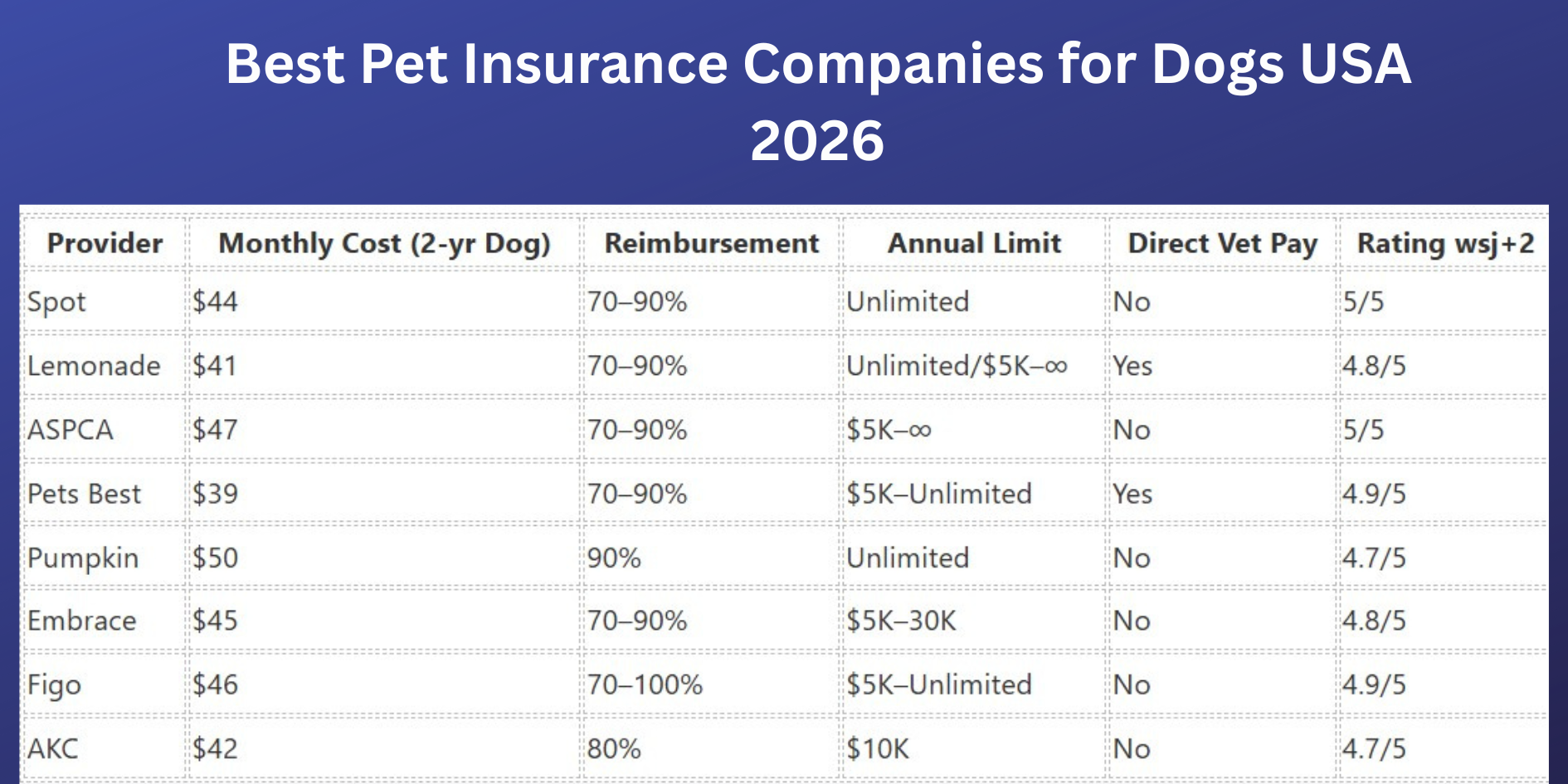
Best Pet Insurance Companies for Dogs USA 2026. The following eight companies have been selected based on coverage breadth, pricing transparency, claims processing speed, and customer satisfaction ratings from 2025–2026 market data.
Why Your Dog Needs Insurance (And Why You Might Not Know It)
If you own a dog, you already know that veterinary care is expensive. What many dog owners discover too late is that a single emergency—such as a torn ligament, poisoning, or cancer diagnosis—can cost $3,000 to $15,000. According to the American Veterinary Medical Association, the average dog owner now spends $598 annually on veterinary care, a figure that climbs steeply when emergencies occur.
Pet insurance reimburses eligible veterinary bills after you pay them out of pocket. Rather than facing the choice between financial hardship and refusing treatment for your pet, insurance lets you say yes to your veterinarian’s recommendations. This article reviews eight leading pet insurance providers based on coverage, cost, claims processing, and suitability for different dog owner situations.
What Is Pet Insurance for Dogs?
Pet insurance is a financial product that reimburses you for eligible veterinary expenses. Unlike human health insurance, you pay your veterinarian directly, then submit a claim to the insurance company for reimbursement. Most policies reimburse between 70% and 90% of covered costs after you meet a deductible.
According to the American Veterinary Medical Association (AVMA) 2025 Pet Owner Economics Report, only approximately 4% of U.S. pets are covered by insurance, despite growing recognition of the financial protection it provides.
How Much Does Dog Insurance Cost?
Dog insurance premiums in 2026 typically range from $30 to $100 per month, depending on the dog’s age, breed, location, and the coverage level selected. The average accident-and-illness plan costs between $40 and $70 monthly for a young, mixed-breed dog.
| Coverage Type | Monthly Cost | What It Covers |
| Accident-Only | $10–$25 | Injuries, poisoning, broken bones |
| Accident & Illness | $40–$70 | + infections, chronic conditions, cancer |
| Comprehensive + Wellness | $80–$120+ | + routine checkups, dental, vaccines |
Note: Rates vary significantly by location, dog breed, and age. Large and senior dogs typically pay higher premiums due to increased health risks. Brachycephalic breeds (Bulldogs, Pugs) often face additional premiums.
Is Pet Insurance Mandatory in the USA?
No. There is no federal law in the United States requiring pet owners to purchase pet insurance. The National Association of Insurance Commissioners (NAIC) has established a Pet Insurance Model Act (adopted in 2022), which 14 states have incorporated into their own insurance regulations to protect consumers. However, pet insurance remains a voluntary financial product. Some housing communities or international travel may require proof of pet liability coverage, but not health insurance.
Top 8 Pet Insurance Companies for Dogs (2026)
These companies operate across most U.S. states and consistently rank highly in independent reviews.
1. Spot Insurance – Best for Unlimited Annual Coverage

Who It’s Best For: Dog owners concerned about catastrophic illnesses or multiple recurring conditions.
Typical Cost: $40–$60 per month for a young, mixed-breed dog with accident-and-illness coverage.
What It Covers: Accidents, illnesses, hereditary and congenital conditions, chronic conditions, cancer, diagnostics, prescription medications, and optional wellness add-ons in most states.
- Pros: Unlimited annual coverage option available; strong coverage for hereditary conditions affecting purebred dogs; highly customizable plans with flexible deductibles ($100–$1,000) and reimbursement rates (70–90%).
- Cons: Premiums may be higher than budget providers when selecting low deductibles and unlimited coverage; plan customization can overwhelm first-time users.
2. Lemonade Pet Insurance – Best Value for Budget-Conscious Dog Owners

Who It’s Best For: Young, healthy dogs where owners prioritize affordability and fast, app-based claims.
Typical Cost: $25–$45 per month for a healthy young dog on an accident-and-illness plan.
What It Covers: Accidents, illnesses, diagnostic tests, medications, and optional packages for exam fees, dental illness, behavioral therapy, physical therapy, and end-of-life care.
- Pros: Competitive premiums for comparable coverage; AI-powered claims approval within minutes for straightforward claims; seamless digital experience from enrollment to claims.
- Cons: Not available in all U.S. states; optional coverages (exam fees, advanced therapies) require add-ons, increasing total cost.
3. ASPCA Pet Health Insurance – Best for Broad, Simple Coverage

Who It’s Best For: Dog owners who want straightforward coverage that works with any licensed veterinarian nationwide.
Typical Cost: $45–$65 per month for accident-and-illness coverage, depending on breed and location.
What It Covers: Accidents, illnesses, hereditary and congenital conditions, behavioral therapy, alternative therapies, and optional wellness coverage.
- Pros: Exceptionally broad standard coverage, including behavioral issues without add-on fees; works with any licensed U.S. veterinarian; multiple annual limit and reimbursement rate options.
- Cons: Entry-level plans may have lower annual limits; higher total cost when adding wellness or selecting higher annual caps.
4. Pets Best – Best for Dogs with Mobility and Orthopedic Concerns

Who It’s Best For: Active dog owners and owners of large breeds prone to joint and ligament injuries (e.g., German Shepherds, Labrador Retrievers).
Typical Cost: Often among the lowest quotes, with accident-and-illness coverage starting in the high $30s per month for younger dogs.
What It Covers: Accidents, illnesses, hereditary conditions, cancer, and optional routine care; many plans offer favorable coverage for orthopedic risks when enrolled before problems arise.
- Pros: Highly competitive pricing relative to coverage level; very short accident waiting period (often just a few days); offers direct vet payment for participating providers, reducing out-of-pocket burden during major surgeries.
- Cons: Some customers report longer reimbursement times on traditional claims during high-volume periods; orthopedic conditions may have special waiting periods.
5. Pumpkin Pet Insurance – Best for Puppies and Young Dogs

Who It’s Best For: Puppy owners starting coverage early to lock in rates and benefit from preventive care.
Typical Cost: $45–$65 per month for accident-and-illness with high (often 90%) reimbursement rates.
What It Covers: Accidents, illnesses, hereditary and congenital conditions, behavioral problems, and emphasized coverage for early-life issues.
- Pros: High reimbursement levels (often 90%) significantly reduce out-of-pocket costs; specifically designed for young pets; wellness add-ons align with puppy needs (vaccines, deworming, microchipping).
- Cons: Premiums rise steeply as dogs age, especially at 90% reimbursement with generous limits; fewer low-budget configurations available.
6. Embrace Pet Insurance – Best for Healthy Pet Discounts

Who It’s Best For: Healthy dogs whose owners want rewards for maintaining good health; multi-pet households.
Typical Cost: Mid-$40s to $60s per month for accident-and-illness plans.
What It Covers: Accidents, illnesses, hereditary conditions, dental illness coverage, and optional wellness through the separate Wellness Rewards product.
- Pros: Broad coverage including behavioral therapy and alternative treatments; unique diminishing deductible feature rewards healthy dogs by reducing annual deductibles over claim-free years; widely available across the U.S.
- Cons: Orthopedic issues may have longer waiting periods (several months) unless special vet exam waivers are obtained; wellness is sold separately, which can feel confusing.
7. Figo Pet Insurance – Best for Fast Digital Claims

Who It’s Best For: Tech-savvy dog owners who want everything handled via smartphone app.
Typical Cost: Mid-$40s for young dogs on standard accident-and-illness plans.
What It Covers: Accidents, illnesses, hereditary conditions, cancer, and some alternative therapies.
- Pros: Highly flexible reimbursement options up to 100% in some states; mobile-first app streamlines claims with photo uploads; very fast claims processing (sometimes paid within days).
- Cons: Wellness coverage may not be as comprehensive or may require add-ons; occasional premium increases at renewal.
8. AKC Pet Insurance – Best for Pre-Existing Condition Coverage

Who It’s Best For: Owners of AKC-registered purebred dogs with known hereditary health risks.
Typical Cost: $40–$60 per month, with potential higher costs for high-risk breeds.
What It Covers: Accidents, illnesses, hereditary and congenital conditions, and optional wellness add-ons designed around breed-specific risks.
- Pros: Breed-specific coverage aligned with AKC-registered dogs; unique potential to cover certain pre-existing conditions after waiting periods and underwriting (rare in the industry); discount incentives for registered litters.
- Cons: Entry-level plans may have lower annual limits unless upgraded; pre-existing condition coverage details are complex and require careful policy review.
How to Choose the Right Pet Insurance for Your Dog?
Follow these steps to find a plan that matches your dog’s health profile and your budget:
- Assess Your Dog’s Needs: Consider your dog’s age, breed, activity level, and any existing health concerns. High-energy breeds prone to injuries may benefit from accident coverage; senior dogs benefit from broader illness coverage.
- Gather Multiple Quotes: Compare at least three providers using your dog’s specific information (breed, age, location). Online quote generators provide instant estimates without committing.
- Review Coverage Details: Look for unlimited annual limits, coverage of hereditary conditions relevant to your breed, exam fee reimbursement, and behavioral therapy if needed.
- Understand Exclusions: Pre-existing conditions (unlikely to be covered), waiting periods (typically 14 days for illness, 1–3 days for accidents), and special waiting periods for orthopedic issues.
- Check Claims Processing: App-based claims (Figo, Lemonade) typically process within days. Traditional submittals may take 2–5 weeks. Direct vet pay (Pets Best) reduces out-of-pocket burden immediately.
- Enroll Early: Lock in lower rates by enrolling before age 3. While there is no upper age limit, senior dogs face significantly higher premiums.
- Read Customer Reviews: Check satisfaction ratings and claims experiences on independent review sites. Real-world experiences with claims handling are invaluable.
Frequently Asked Questions
Which pet insurance company has the best reputation?
No single company is best for everyone. Spot leads for unlimited coverage; Lemonade for affordability; ASPCA for breadth; Pets Best for orthopedic concerns. Reputation depends on aligning the company’s strengths with your dog’s specific needs.
Does pet insurance cover spay and neuter surgeries?
Not typically under accident-and-illness plans. Routine procedures like spaying or neutering require wellness or routine care add-ons, which are usually sold separately or available through specific plans. Some companies (e.g., Pumpkin) include partial wellness coverage in their standard plans.
Can senior dogs get insured?
Yes. Most providers have no upper age limit for enrollment, but premiums increase significantly for dogs over age 10. Embrace and Spot are noted for accepting senior dogs. Premiums may be two to three times higher than for young dogs.
How long does reimbursement typically take?
App-based claims (Figo, Lemonade) may be approved within minutes to a few days. Traditional paper claims typically take 2–5 business days; some providers may take up to 30 days during peak periods.
Are certain dog breeds excluded?
No breed is outright excluded, but brachycephalic breeds (Bulldogs, Pugs, Boston Terriers) typically face higher premiums due to documented health risks. Some providers offer breed-specific wellness plans.
Is there a waiting period before coverage begins?
Yes. Accident coverage typically begins after 1–3 days. Illness coverage usually has a 14-day waiting period. Orthopedic and hereditary conditions may have longer waiting periods (6 months or more). Pre-existing conditions are generally excluded permanently.
Is pet insurance worth the cost for a healthy dog?
Yes. Insurance locks in affordable rates when your dog is young and protects against unexpected emergencies. The average emergency vet bill is $2,000–$5,000; a $600 annual premium provides peace of mind and protects financial security.
Final Thoughts
Veterinary costs continue to rise. According to the American Veterinary Medical Association, dog owners now spend an average of $598 annually on veterinary care, with emergency costs potentially exceeding $10,000. Pet insurance provides financial protection against these unexpected expenses. No single plan is right for everyone. We recommend obtaining quotes from multiple providers and carefully comparing coverage, exclusions, and claims processes. The best insurance is the one you will actually use when your dog needs care.
Compare quotes today to safeguard your dog’s health and your family’s finances.
Sources and References
This article is based on data from authoritative government agencies, industry associations, and peer-reviewed research. All statistics and claims have been verified against official sources.
U.S. Government and Regulatory Sources (Primary Authority)
- National Association of Insurance Commissioners (NAIC) Pet Insurance Model Act (2022) – Framework for state regulation of pet insurance. https://content.naic.org/insurance-topics/pet-insurance
- American Veterinary Medical Association (AVMA) – Official source for U.S. veterinary industry statistics and pet owner economics. See: AVMA 2025 Pet Owner Economics Report; AVMA 2024–2025 Pet Ownership and Demographic Sourcebook.
- S. State Insurance Commissioners (by state) – Regulate pet insurance products and protect consumers. Individual state departments of insurance maintain databases of licensed insurers and coverage requirements.
- California Department of Insurance – Maintains pet insurance resources and consumer guides. https://www.insurance.ca.gov/
Industry Association and Market Data
- North American Pet Health Insurance Association (NAPHIA) – Industry research and state-of-the-industry reports on pet insurance market trends.
- VetSource – Veterinary industry practice management data and economic analysis.
- American Pet Products Association (APPA) – Pet industry spending and ownership demographics.
Key Statistics Cited
- Average dog owner annual veterinary spending: $598 (2025) – Source: AVMA 2025 Pet Owner Economics Report.
- Average cost of last veterinary visit: $200 (2025) – Source: AVMA data.
- Pet insurance penetration: ~4% of U.S. pets – Source: AVMA.
- 14 states have adopted NAIC Pet Insurance Model Act standards (as of 2026) – Source: NAIC and state insurance commission records.
- No federal law mandates pet insurance – Pet insurance is regulated at the state level as casualty/property insurance.
Disclaimer
This article is an expert review for informational purposes only. It is not financial or insurance advice. We do not recommend specific insurance products or guarantee outcomes. Readers should consult directly with insurance providers and their veterinarians to determine the best coverage for their individual circumstances. Insurance terms, coverage, and pricing change frequently; please verify current rates and terms directly with insurers before purchasing.
Last Updated: May 2026. Verification Date: May 29, 2026.

Humera Khan is a professional digital content creator, SEO strategist, and data researcher specializing in the U.S. insurance market. Formally trained in advanced Content Writing, Search Engine Optimization, and Digital Marketing through the DigiSkills.pk program—executed by the Virtual University of Pakistan—Humera applies precise analytical standards to complex financial and corporate policy data. Her core mission for InsuranceInfoUSA is to provide readers with highly credible, transparent, and accessible insurance guidance. To maintain the highest level of factual integrity, her research methodology relies strictly on authoritative, verified industry benchmarks, with complete primary source citations included at the end of every guide to ensure total transparency and data reliability.To ensure total transparency and data reliability. For editorial inquiries or direct questions, she can be reached at Contact@insuranceinfousa.com.