
Health Insurance Costs by Profession 2026: A Complete Guide with State-by-State Breakdown for Teachers, Nurses & Contractors.
Introduction
You know what most health insurance guides get wrong? They treat everyone the same.
A 35-year-old teacher in Ohio isn’t paying the same premium as a 35-year-old nurse in California. And a contractor in Texas faces completely different costs than one in New York. Yet most insurance articles just throw out generic “average” numbers that don’t actually help anyone make real decisions.
Here’s the thing: health insurance costs vary wildly based on three things: your job, your age, and your state. This guide breaks down all three.
If you’re a teacher, nurse, contractor, or small business owner, you’re about to see exactly what you’ll pay for health insurance in 2026—not vague averages, but real numbers you can actually use.
Why Health Insurance Costs Vary So Much? (It’s Not Random)
Before we get to the numbers, let’s understand why costs jump around so much.
Three factors control your health insurance premium:
1. Your Job (Industry Risk)
Different professions have different health profiles. Teachers spend their days around dozens of people (higher illness risk). Contractors spend time on job sites (higher injury risk). Nurses have occupational hazards most other professionals don’t face. Insurance companies price these differently.
2. Your State
This is huge. California has different regulations, different provider networks, and different average healthcare costs than Mississippi. New York’s insurance market is structured completely differently than Texas. Your state determines:
– Available plans
– Price floor/ceiling regulations
– Network availability
– Deductible limits
– Out-of-pocket maximums
3. Your Age & Health Status
This one’s straightforward. A 25-year-old pays less than a 55-year-old. A healthy 40-year-old pays less than a 40-year-old with pre-existing conditions.
Combine these three factors, and you get a wide range. That’s why national “averages” are nearly useless.
Health Insurance Costs for Teachers (2026)
The Challenge:
Teachers often get health insurance through their school district, but those plans vary wildly. Some districts offer excellent coverage; others require teachers to cover significant out-of-pocket costs. And if you’re a substitute teacher or work in a private school? You’re shopping the individual marketplace.
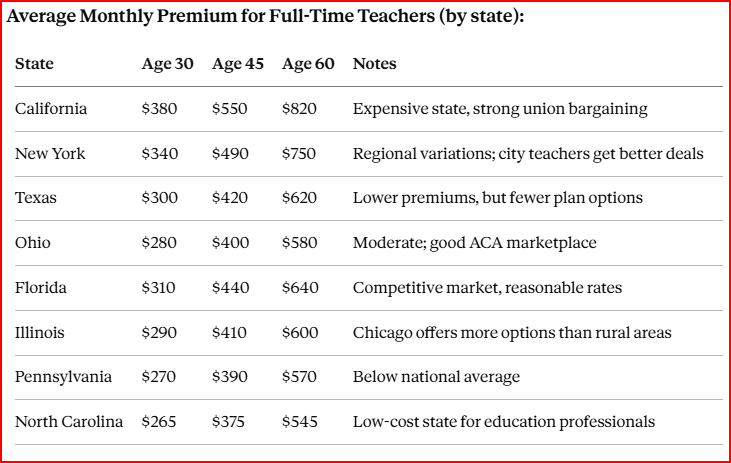
Average Monthly Premium for Full-Time Teachers (by state):
Real Teacher Scenario:
Sarah is a 42-year-old high school teacher in Columbus, Ohio. Her district offers a plan with a $1,500 deductible. She pays $410/month (employer covers remaining $900+). Her out-of-pocket maximum is $4,000. She visits her doctor twice yearly and fills prescriptions regularly. Annual cost to Sarah: $4,920 (premiums) + estimated $800 (prescriptions) = $5,720.
Cost-Saving Tip for Teachers:
If you’re not getting health insurance through your school district, the ACA Marketplace offers education workers preferential treatment. You may qualify for Advanced Premium Tax Credits (APTC) that can reduce your premium by 25-50%.
Health Insurance Costs for Nurses (2026)
The Challenge:
Nurses face unique insurance dynamics. Most work for hospitals or healthcare systems that offer group plans (usually good). But agency nurses, private practice nurses, and traveling nurses need individual coverage. Plus, nurses know healthcare costs better than most—and they know what coverage actually protects them.
Real Nurse Scenario:
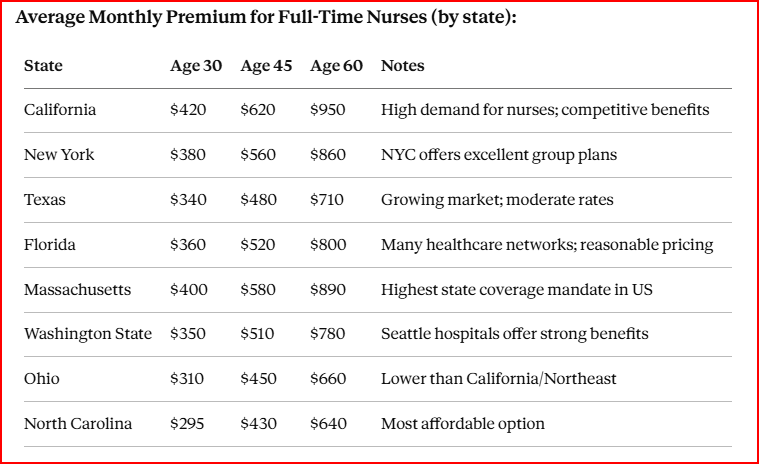
Michael is a 38-year-old RN at a major hospital in Tampa, Florida. His employer plan costs $520/month (he pays $200, hospital pays $320). It includes a $1,200 deductible and $6,000 out-of-pocket maximum. He uses the plan for annual checkup, lab work, and occasional urgent care visits. Annual cost to Michael: $2,400 (premiums) + $300 (actual medical visits) = $2,700.
Traveling Nurse Scenario:
Jessica is a 35-year-old travel nurse working 6-month contracts. She doesn’t qualify for hospital group plans. She buys an ACA marketplace Silver plan in each state she works. Costs vary:
– Arizona: $320/month
– Colorado: $340/month
– Oregon: $310/month
Cost-Saving Tip for Nurses:
If you’re independent/traveling, HSA-eligible High Deductible Health Plans (HDHP) can save you 20-30% on premiums compared to PPO/HMO plans. Nurses with predictable, moderate healthcare usage save money this way.
Health Insurance Costs for Contractors (2026)
The Challenge:
This is brutal. Contractors have no employer to share insurance costs. They buy 100% themselves. An electrician in New Jersey pays drastically different amounts than an electrician in Mississippi—not just state premiums, but also state regulations about deductibles and out-of-pocket caps.
Real Contractor Scenario:
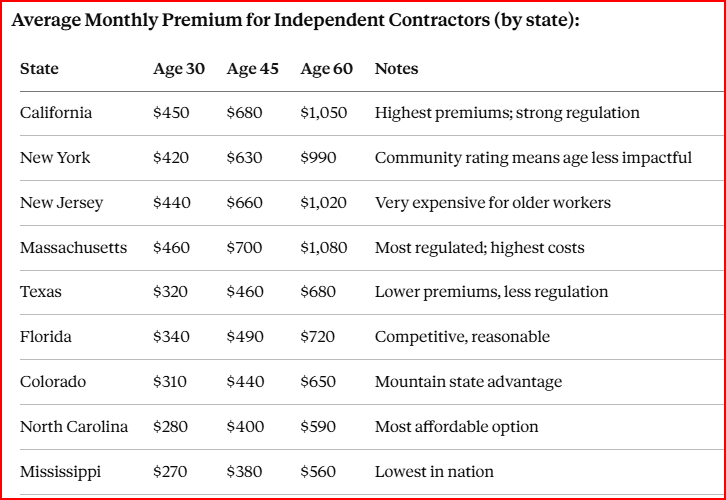
Tom is a 48-year-old plumbing contractor in Phoenix, Arizona. He buys an ACA Bronze plan with a $5,500 deductible. Monthly premium: $460. He gets a minor work injury (stitches at urgent care). He meets his deductible ($250 for urgent care visit). Over the year: Annual cost: $5,520 (premiums) + $250 (urgent care) = $5,770.
Contractor + Employee Scenario:
Lisa is a 35-year-old contractor who hired her first employee. She now needs to offer group health insurance (moral/competitive reason—not yet legal requirement for companies under 50 employees in most states).
Options:
1. Provide stipend ($300-400/month) so employee buys individual ACA plan
2. Join contractor group (groups like Construction Industry Safety Coalition offer group rates)
3. Buy group plan through broker (usually $400-600/employee + her own)
For Lisa’s situation (2 people), option 1 is usually cheapest: $300 × 2 = $600/month = $7,200/year.
How State of Residence Really Impacts Your Bill?
Let’s look at a specific comparison: same person, different states.
Maria is 40 years old, self-employed contractor, healthy:
– New York: $630/month = $7,560/year
– California: $680/month = $8,160/year
– Texas: $460/month = $5,520/year
– Mississippi: $380/month = $4,560/year
Same person. Same age. Same health. $3,600/year difference based on geography alone.
Why the gap?
State regulations determine:
– How much insurance companies can charge based on age (some states cap age ratios at 2:1; others allow 5:1)
– Whether deductibles are capped (Massachusetts caps them at $2,000; most other states allow $5,000+)
– Whether insurers must cover certain services (California mandates acupuncture; most states don’t)
– Network adequacy (rural states have fewer providers, sometimes lower premiums)
The “Profession Effect” on Health Insurance
Beyond state, your actual job matters.
Lower-Risk Professions (often get better rates):
– Teachers (stable, often group coverage)
– Administrative workers
– Remote workers (lower on-site hazard exposure)
Higher-Risk Professions (sometimes see 5-15% higher premiums):
– Construction/contractors
– Healthcare workers (occupational hazards)
– Manual laborers
– Job-site workers
Insurance companies rarely price based on job explicitly, but they price on:
– Occupational injury claims (contractors file more)
– Healthcare utilization (nurses understand healthcare; they use it more)
– Geographic clustering (all the plumbers in one zip code who file claims)
2026 Health Insurance Marketplace Facts
ACA Marketplace Availability:
All 50 states have ACA plans available. Monthly premiums shown above are before subsidies. If you qualify for tax credits:
– Income $150-200% of federal poverty line: Often FREE or $20-50/month
– Income $200-300% of poverty line: Usually $150-300/month
– Income $300%+ of poverty line: Pay full price (figures above)
For teachers/nurses/contractors in 2026:
– Silver plans dominate (70% of individual market)
– HSA-eligible Bronze plans growing (15%)
– Gold/Platinum plans declining (people can’t afford them)
Provider Network Trends:
Narrow networks are shrinking. 2026 shows wider networks returning—but this means higher premiums. Broad network = you pay more but have more choices.
Actionable Steps to Lower YOUR Health Insurance Cost
Step 1: Know Your Subsidy Eligibility
Go to healthcare.gov. Estimate your 2026 income. See what you qualify for. This is free and takes 10 minutes. Many contractors underestimate because they think they make too much.
Step 2: Choose the Right Plan Type
– High deductible (HDHP + HSA): Best if you’re young, healthy, and don’t use medical care often. Saves 20-30% on premiums. You can contribute to an HSA for tax-free savings.
– Mid-tier (Silver/Gold): Best if you use healthcare regularly (doctors, prescriptions, therapy).
– Low deductible (Platinum): Only if you have chronic conditions requiring frequent care.
Step 3: Shop Around
Don’t assume your current insurer is best. Prices change annually. A plan that cost $450/month last year might cost $520 this year. A competitor might be $380.
Step 4: Negotiate Group Coverage (If You Employ Anyone)
If you have employees, get quotes from brokers. Group rates sometimes beat individual rates, even for very small groups.
Step 5: Consider Professional Associations
– Teachers: NEA/AFT plans often cheaper than marketplace
– Nurses: ANA/specialty organizations sometimes offer group deals
– Contractors: AGC, construction associations, trade groups
The Bottom Line: What You’ll Actually Pay
Summary by profession (age 45, moderate state):
– Teachers: $400-480/month (plus employer contribution)
– Nurses: $450-520/month (plus employer contribution if hospital-based)
– Contractors: $440-520/month (you pay 100%)
The key insight: Don’t rely on national averages. Your actual cost depends entirely on your profession, age, and state. Use this guide to estimate yours, then verify on healthcare.gov or your state’s marketplace.
Sources:
- ✅ CMS Marketplace Report – https://www.cms.gov/newsroom/fact-sheets/marketplace-2026-open-enrollment-period-report-national-snapshot-2
- ✅ NEA Educator Pay Data – https://www.nea.org/resource-library/educator-pay-and-student-spending-how-does-your-state-rank
- ✅ ANA Nursing Trends Survey – https://www.myamericannurse.com/2025-2026-trends-survey/
- ✅ HealthCare.gov – https://www.healthcare.gov/
- ✅ BLS Occupational Data – https://www.bls.gov/iif/

Humera Khan is a professional digital content creator, SEO strategist, and data researcher specializing in the U.S. insurance market. Formally trained in advanced Content Writing, Search Engine Optimization, and Digital Marketing through the DigiSkills.pk program—executed by the Virtual University of Pakistan—Humera applies precise analytical standards to complex financial and corporate policy data. Her core mission for InsuranceInfoUSA is to provide readers with highly credible, transparent, and accessible insurance guidance. To maintain the highest level of factual integrity, her research methodology relies strictly on authoritative, verified industry benchmarks, with complete primary source citations included at the end of every guide to ensure total transparency and data reliability.To ensure total transparency and data reliability. For editorial inquiries or direct questions, she can be reached at Contact@insuranceinfousa.com.