
How does short term disability insurance work in california?
In California, short-term disability insurance (SDI) is a state-run program that replaces part of your income when you can’t work due to a non-work-related illness, injury, or pregnancy. It’s funded through mandatory payroll deductions and managed by the Employment Development Department (EDD), ensuring workers have temporary financial support while recovering. Nolo Employment Development Department Disability Secrets
How It Works?
California’s SDI program provides wage replacement benefits for up to 52 weeks. If you’re employed and have paid into SDI (usually shown as “CASDI” on your paycheck), you can file a claim when you’re medically certified as unable to work. The EDD reviews your claim and calculates your benefit based on your earnings during a “base period”—the 12 months ending before the last completed calendar quarter when you file.
💰 Benefit Amounts
Most people receive 60–70% of their regular wages, depending on income level. Payments are made every two weeks via direct deposit or debit card. The maximum weekly benefit adjusts annually; for 2026, it’s around $1,620 per week.
👩⚕️ Eligibility Requirements
To qualify, you must:
- Have earned at least $300 in wages during your base period.
- Have SDI deductions taken from your pay.
- Be under medical care and certified by a licensed health professional.
- Be unable to perform your regular job duties for at least eight consecutive days.
- Submit your claim within 49 days of becoming disabled.
🧾 Filing a Claim
You can apply online through myEDD, the state’s secure portal. You’ll need:
- Your medical certification form.
- Employer details and wage history.
- Bank information for direct deposit.
Once approved, benefits continue until you recover, reach the program’s time limit, or transition to long-term disability or another support program.
⚖️ Key Differences from Workers’ Compensation
SDI covers non-work-related conditions only. If your disability stems from a workplace injury, you must file under workers’ compensation, not SDI.
👶 Related Programs
California also offers Paid Family Leave (PFL) under the same SDI system, allowing time off to care for a sick family member or bond with a new child.
🧠 Human Takeaway
Think of SDI as a safety net—it’s not charity or employer generosity, but a benefit you’ve earned through your own contributions. It helps you stay financially stable while focusing on recovery, without worrying about losing your home or skipping medical care.
| Aspect | Short‑Term Disability | Long‑Term Disability |
|---|---|---|
| Provider | State‑run program through California’s EDD | Private insurance companies or employer‑sponsored plans |
| Coverage Duration | Up to 52 weeks | Several years, often until retirement age depending on policy |
| Funding Source | Funded by payroll deductions (CASDI) | Funded by premiums paid by employee or employer |
| Eligibility | Must have paid into SDI, earned at least $300 in base period, and be medically certified | Must meet insurer’s definition of disability, usually stricter and longer waiting period |
| Benefit Amount | About 60–70% of wages, capped at a weekly maximum set by the state | Typically 50–60% of income, capped by policy terms |
| Waiting Period | Benefits start after 7 days of disability | Benefits usually start after 90–180 days (elimination period) |
| Covered Conditions | Non‑work‑related illness, injury, pregnancy | Serious long‑term illnesses, injuries, or permanent disabilities |
| Administration | Managed by California Employment Development Department (EDD) | Managed by private insurers or employer benefit administrators |
| Relation to Workers’ Comp | Covers non‑work‑related disabilities only | May coordinate with workers’ comp but usually applies to non‑work disabilities |
California short term disability policy
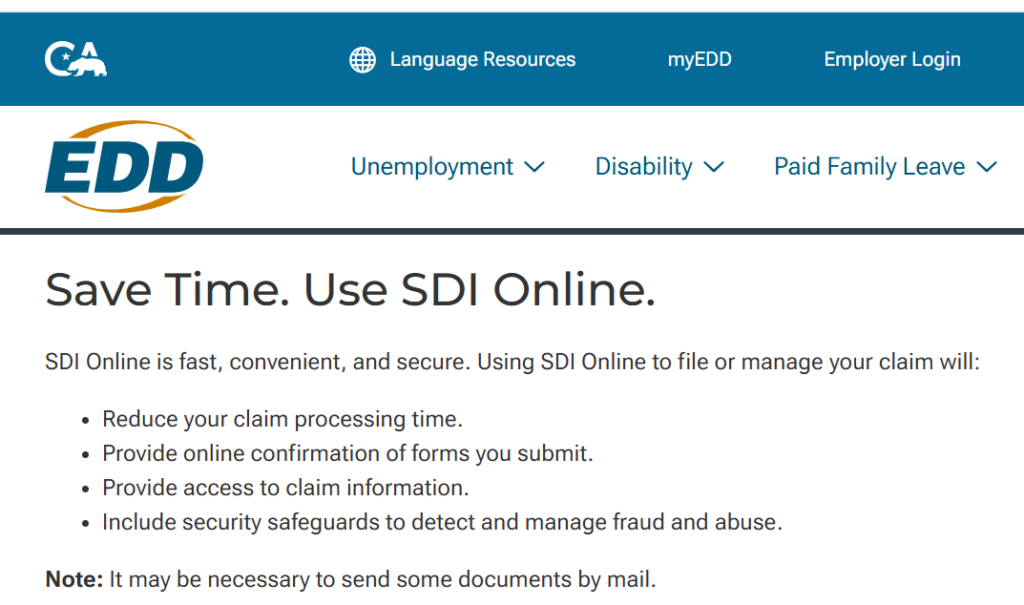
California’s short‑term disability insurance (SDI) is a state‑run program that provides temporary wage replacement when workers cannot perform their job due to a non‑work‑related illness, injury, or pregnancy.
Administered by the Employment Development Department (EDD), it is funded through mandatory payroll deductions shown as “CASDI” on paychecks. Eligible employees who have earned at least $300 in wages during their base period and paid into SDI can receive about 60–70% of their regular income, up to a weekly maximum set by the state, for as long as 52 weeks.
To qualify, a licensed medical provider must certify the disability, and claims must be filed within 49 days of becoming unable to work. Benefits begin after a short waiting period and are paid biweekly until recovery or program limits are reached.
Unlike workers’ compensation, SDI only covers non‑work‑related conditions, but it also connects to California’s Paid Family Leave (PFL) program, which allows time off to bond with a new child or care for a sick family member. In simple terms, SDI acts as a financial safety net, helping Californians focus on recovery without losing all of their income.
Do i need short term disability insurance in california?
In California, short‑term disability insurance (SDI) is not something you typically need to buy privately because the state already provides a mandatory program through the Employment Development Department (EDD), funded by payroll deductions from most workers’ paychecks; this program offers partial wage replacement if you are unable to work due to a non‑work‑related illness, injury, or pregnancy, so while you don’t need to purchase separate coverage to access these benefits, some people still choose supplemental private disability insurance if they want higher payouts or longer coverage periods than the state plan provides.
What qualifies for short term disability insurance in California?
In California, you qualify for short‑term disability insurance (SDI) if you are unable to perform your regular job duties for at least eight consecutive days due to a non‑work‑related illness, injury, surgery, pregnancy, or childbirth, provided you have lost wages, earned at least $300 in your base period with SDI payroll deductions, and submit medical certification from a licensed practitioner; claims must be filed within 49 days of becoming disabled, benefits generally replace 60–70% of wages (up to 52 weeks), and while SDI does not cover work‑related injuries or very short conditions under eight days, it serves as a vital safety net for most California workers who contribute through payroll deductions.
How to get short term disability insurance in California?
In California, you don’t need to buy separate short‑term disability insurance because the state provides a mandatory program called State Disability Insurance (SDI), which most workers automatically pay into through payroll deductions shown as “CASDI” on pay stubs; to get benefits, you file a claim with the Employment Development Department (EDD) online via the myEDD portal, by mail, or through your doctor’s office, providing medical certification of your disability, employer and wage details, and bank information for direct deposit, after which the EDD reviews your eligibility and pays you about 60–70% of your regular wages (up to 52 weeks), making SDI a built‑in safety net for California workers facing non‑work‑related illness, injury, pregnancy, or childbirth.
Who pays for short term disability in california california short term disability policy?
In California, short‑term disability insurance (SDI) is paid for by employees themselves through mandatory payroll deductions, which appear as “CASDI” or “SDI” on pay stubs; these contributions go into a state‑managed fund overseen by the Employment Development Department (EDD), and when a worker becomes unable to work due to a non‑work‑related illness, injury, pregnancy, or childbirth, the EDD uses that pooled fund to provide partial wage replacement benefits—typically 60–70% of regular wages for up to 52 weeks—so the program is essentially self‑funded by workers rather than employers or general tax revenue.
Sources
- California EDD – State Disability Insurance (SDI)
- California EDD – Disability Insurance Benefits Overview
- California EDD – SDI Online Portal
https://edd.ca.gov/en/disability/State-Disability-Insurancehttps://edd.ca.gov/en/disability/Disability-Insurancehttps://edd.ca.gov/en/disability/SDI_Online

Humera Khan is a professional digital content creator, SEO strategist, and data researcher specializing in the U.S. insurance market. Formally trained in advanced Content Writing, Search Engine Optimization, and Digital Marketing through the DigiSkills.pk program—executed by the Virtual University of Pakistan—Humera applies precise analytical standards to complex financial and corporate policy data. Her core mission for InsuranceInfoUSA is to provide readers with highly credible, transparent, and accessible insurance guidance. To maintain the highest level of factual integrity, her research methodology relies strictly on authoritative, verified industry benchmarks, with complete primary source citations included at the end of every guide to ensure total transparency and data reliability.To ensure total transparency and data reliability. For editorial inquiries or direct questions, she can be reached at Contact@insuranceinfousa.com.